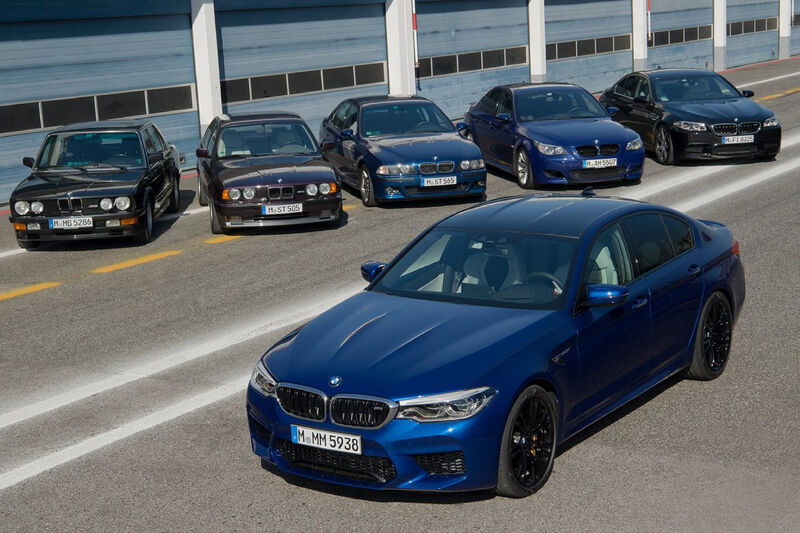
The Legendary BMW M5: A Triumph of Performance Engineering and Innovation
Since its inception in 1984, the BMW M5 has been the epitome of a high-performance sports sedan, combining precision engineering, cutting-edge technology, and unmistakable styling. Revered by car enthusiasts worldwide, the M5 has become a legend, leaving an indelible mark on the automotive industry. In this article, we take a journey back in time to explore how the iconic BMW M5 was created.
Birth of the M Division
To understand the genesis of the BMW M5, we must first delve into the origins of BMW's Motorsport division, known simply as "M." Established in the early 1970s, BMW's Motorsport division was dedicated to developing high-performance versions of their road-going vehicles, focusing on enhanced driving dynamics and exhilarating experiences.
The M Division's early accomplishments, such as the BMW 3.0 CSL, laid the groundwork for the development of future iconic M models, including the M1, M3, and, of course, the M5.
The First Generation: E28 M5 (1984-1988)
The debut of the BMW M5 took place at the Amsterdam Motor Show in February 1984, marking the birth of an automotive icon. The first-generation M5, based on the E28 5 Series sedan, was a true pioneer in its category. It featured a 3.5-liter inline-six engine with individual throttle bodies, producing an impressive 282 horsepower and 251 lb-ft of torque. With its performance-tuned suspension, larger brakes, and distinct M-specific styling elements, the E28 M5 became an instant success among driving enthusiasts.
The Second Generation: E34 M5 (1989-1995)
Building upon the success of the E28, BMW introduced the second-generation M5, based on the E34 5 Series platform. Launched in 1989, this iteration showcased significant advancements in performance and luxury. The E34 M5 was powered by a 3.6-liter inline-six engine, delivering 311 horsepower and 266 lb-ft of torque, propelling it to 60 mph in under six seconds. Technological innovations, including an adaptive suspension system and a six-speed manual transmission, solidified its reputation as a super sedan.
The Third Generation: E39 M5 (1998-2003)
In 1998, BMW unveiled the E39 M5, taking the legendary model to new heights. Under the hood, the E39 M5 featured a 4.9-liter V8 engine, producing an astonishing 394 horsepower and 369 lb-ft of torque. With this powerplant and a new six-speed manual gearbox, the E39 M5 accelerated to 60 mph in just 4.8 seconds. The E39 M5 was revered not only for its blistering performance but also for its balanced and engaging driving dynamics, setting a new standard for the sports sedan segment.
The Fourth Generation: E60 M5 (2005-2010)
As the automotive world transitioned into the 21st century, so did the BMW M5. In 2005, the E60 M5 was introduced, making a significant departure from its predecessors. Under the hood lurked a potent 5.0-liter V10 engine, generating an astonishing 500 horsepower and 383 lb-ft of torque. The E60 M5's advanced seven-speed SMG transmission enabled lightning-fast gear shifts, enhancing its performance capabilities. However, some purists yearned for the familiarity of a manual gearbox, which was not offered in this generation.
The Fifth Generation: F10 M5 (2011-2016)
The F10 M5, introduced in 2011, embraced a return to turbocharging, employing a 4.4-liter twin-turbocharged V8 engine. This powerplant unleashed an incredible 560 horsepower and 500 lb-ft of torque, while still being more fuel-efficient than its predecessor. With the introduction of an optional seven-speed dual-clutch transmission, the F10 M5 demonstrated unprecedented acceleration and handling capabilities, affirming its status as a dominant force in the sports sedan domain.
The Sixth Generation: F90 M5 (2017-present)
The most recent iteration of the BMW M5, the F90, arrived in 2017, setting a new benchmark for performance sedans. Building upon the strengths of its predecessors, the F90 M5 retained the twin-turbocharged V8 engine but now cranked the power up to a staggering 600 horsepower in the standard version and 617 horsepower in the Competition model. The F90 M5's intelligent all-wheel-drive system (xDrive) allowed for various driving modes, giving the driver full control over the driving experience.
Conclusion
The BMW M5's storied history showcases the relentless pursuit of automotive excellence by BMW's M Division. Each generation of the M5 pushed the boundaries of performance, innovation, and driving pleasure, making it an unparalleled icon among sports sedans. As BMW continues to evolve its M models, the legacy of the M5 lives on, captivating enthusiasts and setting the bar for what a true high-performance sports sedan should be.